Media response: The Economist
You may have seen the recent Economist article claiming that 10-20% of women are unable to produce enough breastmilk:
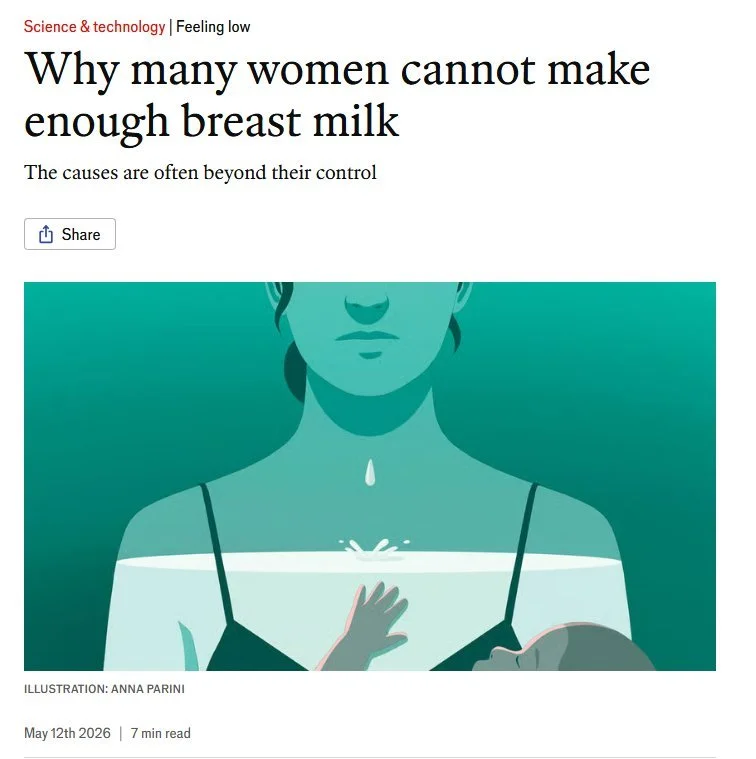
This article discusses, in part, the number of lactocytes present in breastmilk in Western women as an indicator of low supply.
Their claim is that some women have fewer lactocytes and that's why they don't make as much milk.
Unfortunately, the article isn't well cited but here's what I know, which I think is important to add to the conversation:
1. Lactocytes are the cells that make milk. If you are having supply problems, these cells begin to "die off" (involution.) So if a study is looking at lactocyte levels in someone with low milk supply, they're going to have fewer lactocytes compared to someone with full milk supply. This is my biggest concern the discussion in the article, because low lactocytes are absolutely an indicator of low milk supply - if your baby has a shallow latch or doesn't feed often because they're sleepy, your lactocytes will decline, reducing milk supply.
One of the things The Economist seems to be saying is "fewer lactocytes = the reason you can't breastfeed", and that might be true, but how are researchers testing this hypothesis? The article doesn't tell us, and it doesn't link us to the actual research, either.
2. The study methods used for looking at lactocyte levels are... Tricky. If you're using donated breastmilk that's been frozen, some of the cells including lactocytes will have died off during freezing. So you'll find less of them in the sample. Another method called flow cytometry was looked at by researchers recently and they found that it also records lactocyte levels as lower than they really are. (Gleeson et al, 2022. "Profiling of mature-stage human breast milk cells identifies six unique lactocyte subpopulations")
This means that we can't be sure (in absence of proper citations, The Economist ) what methods are being used to reach the "some women can't breastfeed because their bodies just make less lactocytes" claim.
Here's the thing that bothers me, though. If this article is correct, if the research is pointing towards something different about western women's bodies - that's important information, especially in my particular area of work around breastfeeding grief, low milk supply, and how society and culture impacts infant feeding. But if they're wrong... If the author has misunderstood the science, if the researchers are funded by a company with conflicting interests, if the methodology is just poor - then we risk spreading anxiety, along with the already deeply ingrained idea that there is something wrong with our breasts in the West - especially in the UK.
An article with claims like the ones the Economist is making, without proper citations doesn't provide public education, it provides clicks...
And then I spend my early Monday morning lost in Google Scholar and I come away just feeling frustrated…